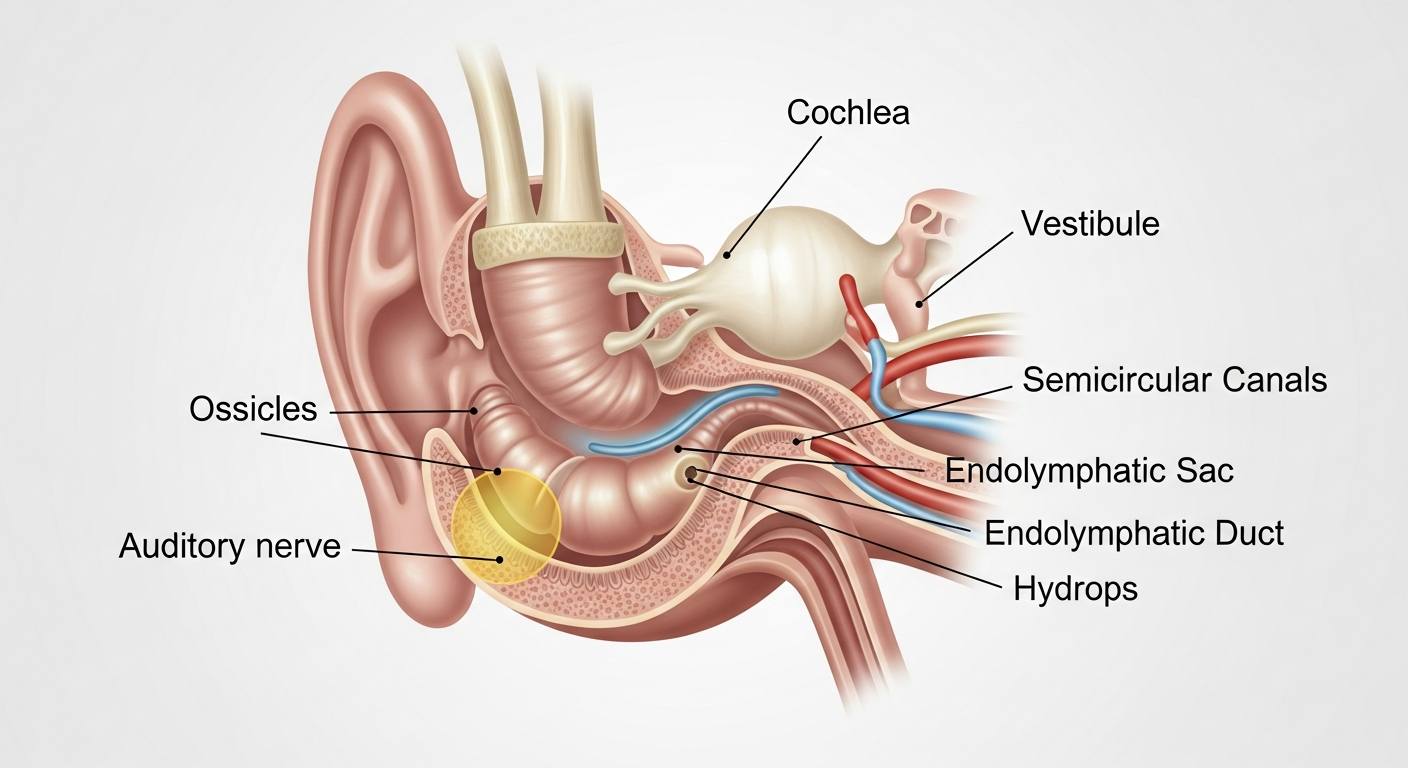
Ménière’s disease is a chronic inner-ear disorder that causes unpredictable episodes of spinning vertigo, fluctuating hearing loss, ringing in the ears (tinnitus), and a sensation of ear fullness. According to patient health resources, all four symptoms typically occur together during Ménière’s disease attacks. These episodes can last from minutes to several hours before easing, only to return later. To better explain how symptoms evolve over time, doctors and hearing specialists classify the condition into the 4 stages of Ménière’s disease, often referred to as the early, middle, late, and burnout stages. In Stage 1 (early stage), sudden vertigo attacks occur, but hearing and balance usually recover between episodes. By Stage 4 (the burnout or end stage), vertigo often stops completely, while hearing loss and balance problems become permanent. Understanding the 4 stages of Ménière’s disease can help patients know what to expect as the condition progresses.
Stage 1: Early (Initial) Ménière’s
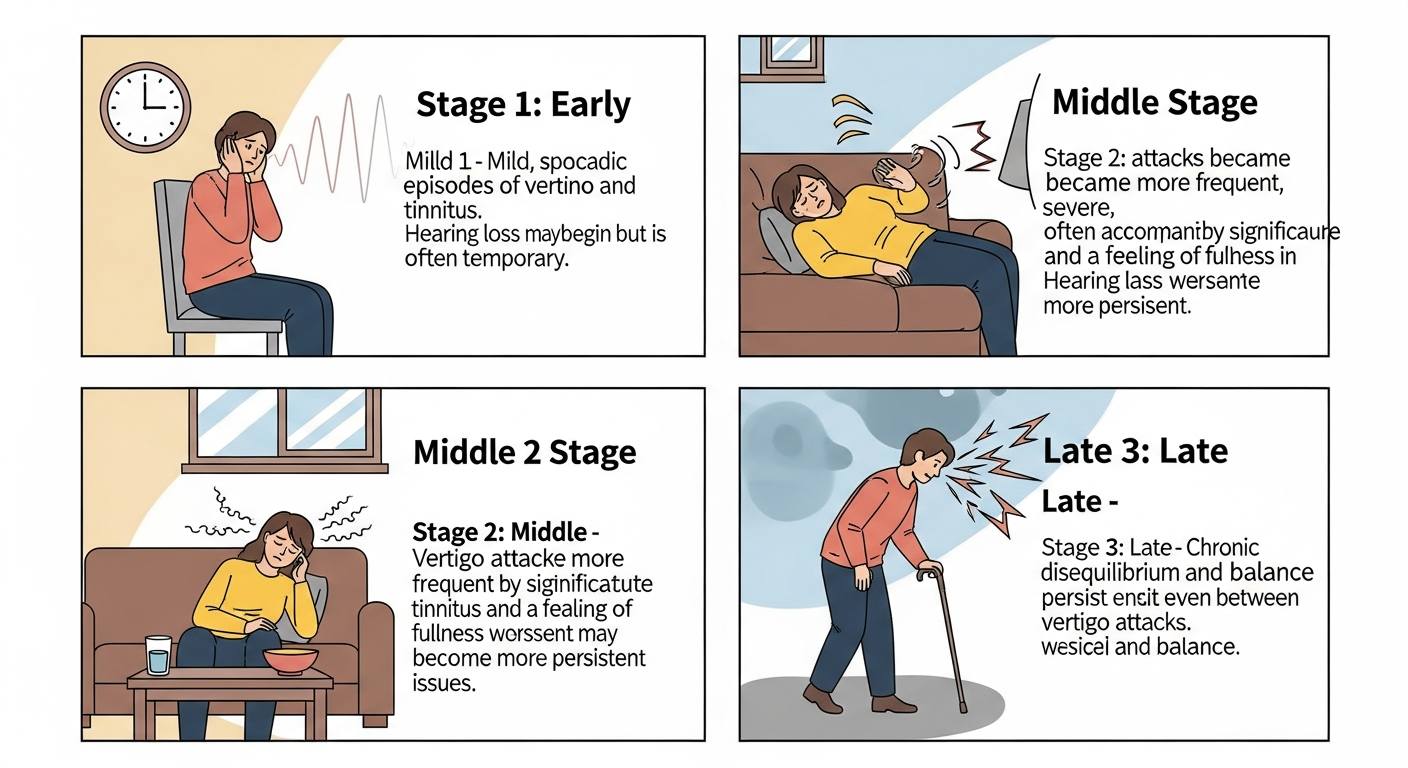
In the first stage, people typically have sudden, unpredictable attacks of spinning vertigo. A vertigo spell can feel like the room is whirling and may last minutes to hours, often with nausea or vomiting. During these early episodes, hearing often becomes muffled or soft (usually in one ear), but then bounces back to normal after the attack. You may also notice bursts of tinnitus (ringing or buzzing) and a sense of pressure or fullness in the affected ear right before or during an attack. Because these symptoms clear between episodes, it’s easy to dismiss the first few attacks as isolated or stress‐related. But these early-stage attacks are the warning signs of Ménière’s.
For example, one hearing health source describes Stage 1 as “unpredictable episodes of vertigo, fullness in the ear, fluctuating hearing loss, and bursts of tinnitus,” with hearing returning to near-normal between attacks. Castle Rock Ear Associates likewise explains that early-stage vertigo is “sudden and unpredictable” and is usually accompanied by nausea; hearing can fluctuate during attacks and you may feel ear fullness. In short, Stage 1 is characterized by severe, brief vertigo episodes but no permanent damage yet.
Stage 2: Middle (Intermediate) Ménière’s
In the middle stage, vertigo attacks are still possible but often become less frequent or a bit milder. However, the other symptoms start to worsen. Hearing loss and tinnitus (ear ringing) become more pronounced and persistent. Castle Rock Ear Associates notes that in the middle stage, “vertigo episodes may become less frequent but can still be debilitating,” while “hearing loss and tinnitus typically become more pronounced”. In practical terms, this means you might have longer stretches without vertigo, but your ear noises (tinnitus) will be louder or more constant, and you may notice a steady drop in hearing. Many patients also begin to feel balance or dizziness issues even between attacks – for example, feeling a bit off-balance when walking or standing.
Your ear may feel continually full or plugged during Stage 2, rather than just before an attack. InsightCLA explains that fullness in the ear often becomes constant in this stage, and people can experience more fatigue or brain fog from dealing with constant symptoms. Castle Rock Ear Associates also mentions that some people notice periods of remission in Stage 2 – times when symptoms briefly ease up – but overall the trend is toward more persistent hearing/tinnitus problems.
Stage 3: Late Ménière’s
By the late stage, true vertigo attacks are much less common. The disease has typically done permanent damage to the inner ear by now. Most patients in Stage 3 have significant, permanent hearing loss in the affected ear. Tinnitus tends to remain loud and constant. Castle Rock Ear Associates describes late-stage Ménière’s as a point where “vertigo attacks are rare, but balance issues may persist” and “permanent hearing loss and worsening tinnitus are common”.
Balance and dizziness can still be problems in Stage 3, especially in the dark or on uneven ground. InsightCLA notes that people often feel unsteady (especially without visual cues) because their inner ear balance organ is damaged. In practice, Stage 3 patients often avoid situations that could trigger dizziness (like busy crowds or busy driving) because their balance is shaky. The phrase “steady as she goes” starts to apply less: even when you’re not having a vertigo attack, you may notice a wobbly or off-balance feeling creeping in.
Importantly, Stage 3 signals that vertigo is finally tapering off, but at the cost of hearing. Over the long term, a medical review notes that if untreated, Ménière’s can lead to “permanent hearing loss” – often developing over many years. In other words, each severe episode in Stages 1–3 chips away at hearing, and by Stage 3 the damage is largely done.
Stage 4: Burnout (End) Ménière’s
The final stage of Ménière’s is sometimes called the “burnout” or “end” stage. In this phase, vertigo attacks usually stop altogether. That may sound like good news, but it means the inner ear’s balance organ has essentially stopped working. The trade‐off is that hearing loss and balance problems remain permanent and often severe. For example, Amplifon reports that in Stage 4 “vertigo attacks typically stop but hearing loss and balance issues remain,” with hearing loss often severe or complete. Castle Rock Ear Associates similarly notes in the end stage the affected ear is “profoundly impaired” and that mobility can be chronically difficult.
Many patients describe Stage 4 as a tricky time. Vertigo is no longer an issue, but the world can feel very quiet (or plugged) and you must rely on other senses to stay steady. The constant tinnitus and hearing loss can be very frustrating. Some people even experience drop attacks at this stage: a sudden fall triggered by a tiny balance disturbance, yet without losing consciousness. Cleveland Clinic explains that Ménière’s vertigo can be so severe that it causes “drop attacks,” where a person suddenly falls from a vertigo spell. By Stage 4, those drop attacks may become more common because each remaining vertigo is powerful.
Importantly, not everyone reaches Stage 4. Ménière’s progression can vary a lot from person to person. Some may plateau in Stage 2 or 3 for years. But the stage model is useful for understanding symptom trends: early stages are vertigo‐dominated, later stages are hearing‐loss dominated.
Coping with Ménière’s and Treatment
There’s currently no cure for Ménière’s disease, but many treatments and lifestyle changes can help manage each stage’s symptoms. In the early stages, patients may benefit most from diet and stress strategies. For example, doctors often recommend a low-sodium diet, limited caffeine and alcohol, and stress management to reduce the frequency of attacks. Keeping hydrated and avoiding sudden head movements can also help.
Medications can help too. Diuretics (water pills) or steroids may be prescribed to ease inner-ear fluid pressure, and anti-nausea or anti-vertigo pills (like meclizine) can make an attack less intense. As hearing loss becomes permanent, hearing aids or other assistive devices become important for communication. Vestibular (balance) rehabilitation – a special form of physical therapy – can retrain the brain to use vision and proprioception to balance better, reducing falls. In severe cases, some patients try injections (gentamicin or steroids in the ear) or surgery to control vertigo, as discussed by Cleveland Clinic.
The key is working closely with a specialist to tailor treatment to your stage. As one expert guide puts it, “symptoms worsen over time and may cause permanent hearing loss and ongoing balance issues. Treatments like medications and therapy can help manage this condition”. In practice, many people learn to live well with Ménière’s by adjusting daily routines (avoiding known triggers) and using targeted treatments at each stage.
In summary, Ménière’s disease often moves through four broad stages. Early on, the attacks are loud and scary but leave no lasting deficit; later on, vertigo fades as hearing and balance loss set in. Knowing about these stages can help patients and caregivers prepare for what’s next. By recognizing which stage you’re in, you can work with your doctor on the right strategies – from salt restriction and stress relief to hearing aids and balance therapy – to maintain the best possible quality of life at every step.