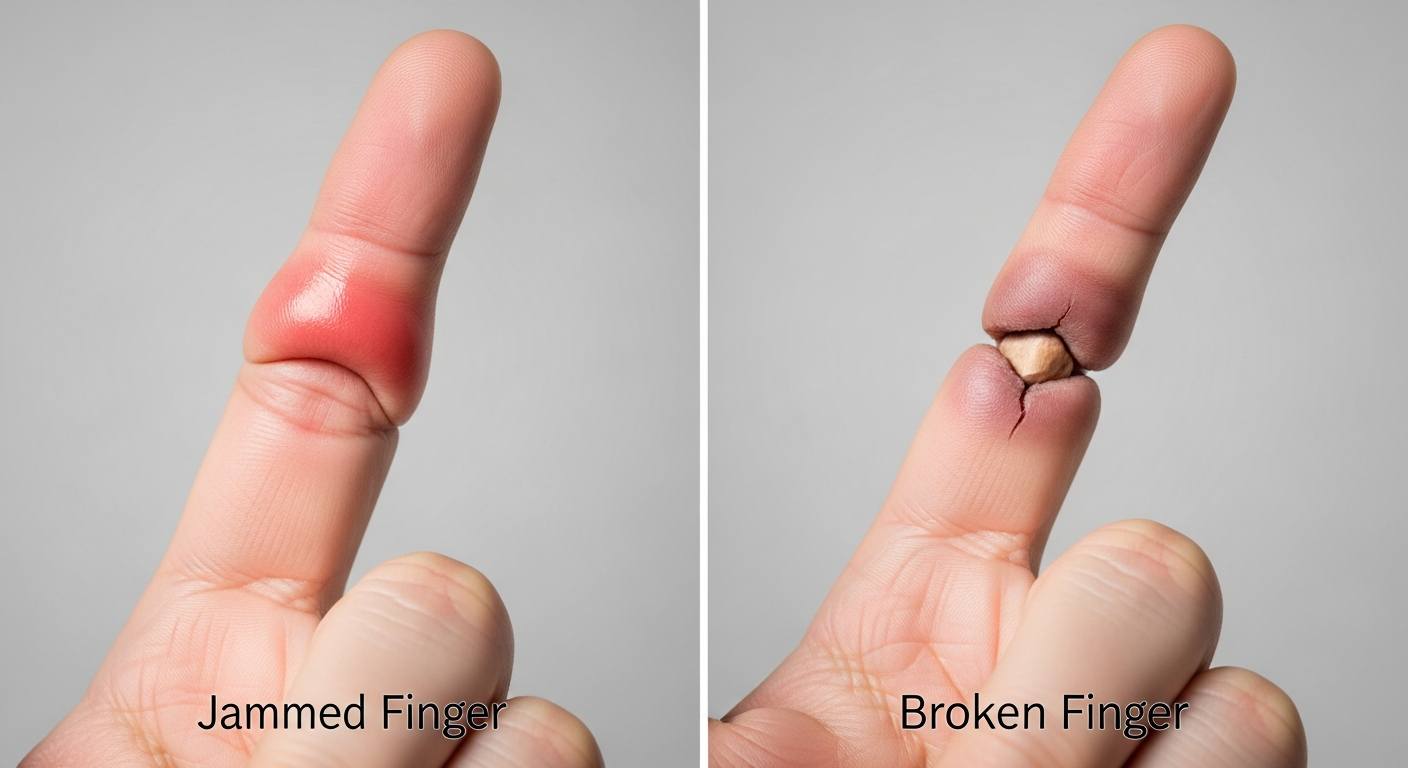
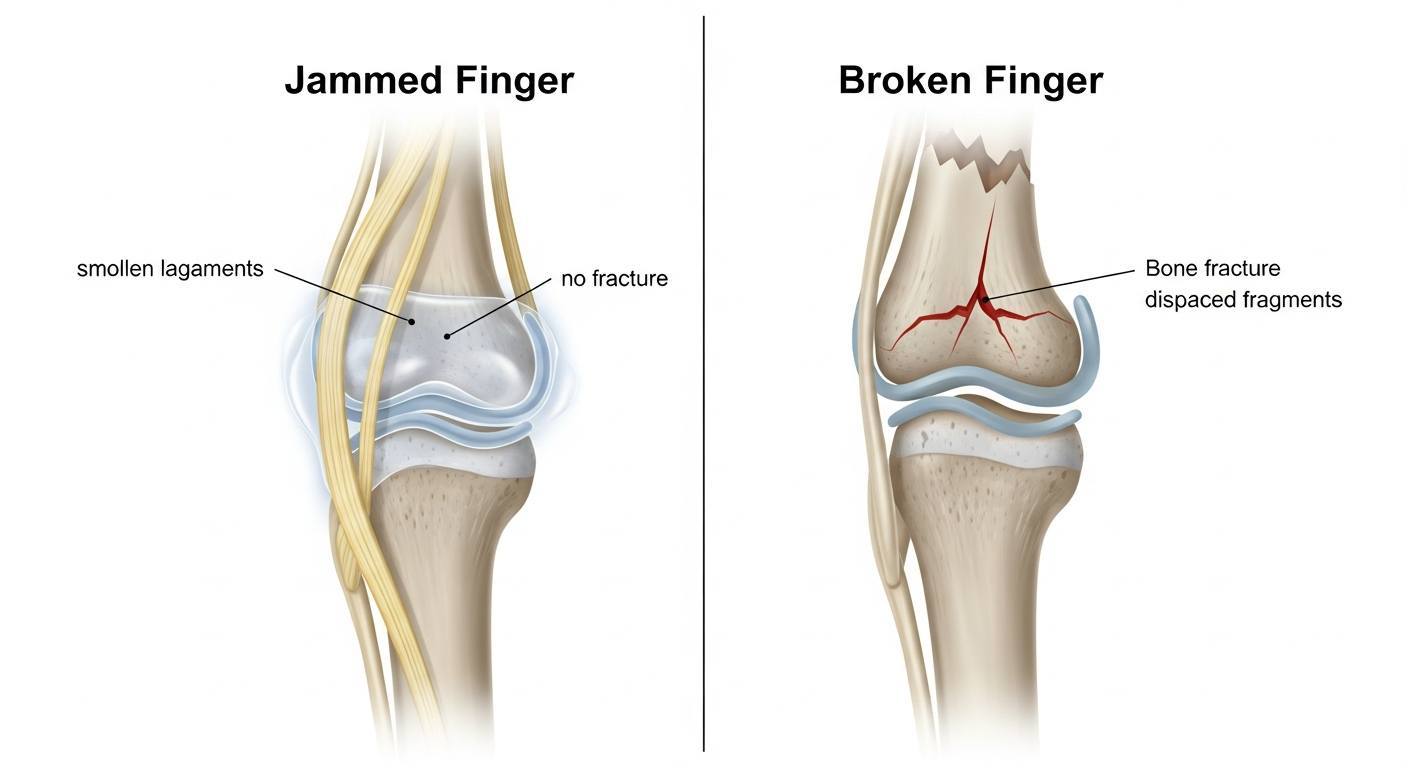
A jammed finger is essentially a sprain – an injury to the ligaments and soft tissues around a finger joint – whereas a broken finger means one of the finger bones is cracked or fractured. In simple terms, both hurt, but a broken finger is usually much worse. Jammed fingers are painful, swollen, and stiff, but often improve in a few days with home care like rest, ice, and gentle taping. By contrast, a broken finger typically causes severe, worsening pain, heavy swelling or bruising, and sometimes an obvious deformity (it may look crooked or bent). Broken fingers almost always need professional care (X‑rays, splints or casts) to heal properly.
What Is a Jammed Finger?
A jammed finger (also called a sprained finger) happens when the ligaments around a finger joint are stretched or partially torn. This usually occurs from a sudden impact: for example, catching a ball wrong, slamming a door, or a fall. The most common spot is the middle joint of the finger (the one that bends in the middle).
When you jam a finger, you’ll usually feel pain and tenderness at the joint, but typically not extreme pain. The finger often swells and may turn red or slightly purple. It might feel stiff, and you may have difficulty gripping things, but you can often still move the joint a little. In other words, a jammed finger hurts and looks puffy, but it may still bend and straighten somewhat. Most jammed fingers aren’t serious: you can usually treat a mild jam at home and expect improvement within a week or two.
Common symptoms of a jammed finger include: pain when you move it, mild-to-moderate swelling, redness, and some stiffness or weakness. For many people, the pain is mostly when using the finger, not constant or throbbing at rest. (If symptoms stay very severe, it could be more serious.)
What Is a Broken Finger?
A broken finger (fracture) means one of the finger’s bones is cracked or shattered. This usually happens from a harder impact: a fall onto the hand, getting hit by something heavy, or a violent twisting. Broken fingers can happen in sports (like if a ball smacks your finger) or accidents (trapping a finger in a door, etc.).
Broken fingers typically cause intense, sharp pain right away – much worse than a simple jam. The finger swells quickly and may bruise (turn purple/blue) within minutes. Often the finger will look crooked, bent strangely, or deformed. In some cases, part of the bone can even poke through the skin. You might hear or feel a crack or pop at the moment of injury. Importantly, you usually can’t move the finger normally – it may be too painful to bend or straighten it at all.
Cleveland Clinic notes that broken fingers share some symptoms with jams (swelling, pain, stiffness) but key red flags are bruising, severe pain, an inability to move the finger, and an irregular (“out of shape”) appearance. If a finger “won’t budge” or looks visibly off, assume it might be broken.
Key Differences: Jammed vs Broken
-
Pain level: A jammed finger hurts, but usually only with movement. A broken finger often has sharp, throbbing pain even at rest, which may get worse over time.
-
Swelling & bruising: Both injuries swell, but breaks swell much faster and more intensely. Deep bruises (dark purple/blue) within minutes of injury strongly suggest a fracture. Jams may swell but usually less dramatically, and the swelling often improves in a few days.
-
Deformity: A jammed finger might look a bit puffy or bent slightly from swelling, but it stays roughly aligned. A broken finger often looks crooked or twisted. If your finger is visibly out of place or bent oddly, it’s likely broken. (Don’t try to push it back yourself – that can make things worse.)
-
Movement: With a jam, you can usually wiggle or bend the finger a bit, even if it’s sore. With a fracture, you may hardly move it at all because it’s too painful. Doctors often check this: if you can move the injured finger only slightly, it’s more likely a jam; if you can’t move it, think fracture.
-
Numbness or tingling: Breaks can damage nearby nerves. If part of your finger feels numb, pins-and-needles, or “dead,” it’s a serious warning sign. Jammed fingers rarely cause numbness. (Also watch for the finger turning very pale or white – that means poor blood flow, which needs urgent care.)
In short, broken fingers cause worse symptoms across the board. Prime Surgical Suites emphasizes that severe swelling/bruising and any crooked appearance are clear hints of a break. If the pain and swelling are so intense that rest and ice don’t help, assume it could be broken.
Treatment and Recovery
-
Jammed Finger (Sprain): If it looks like a jammed finger – no deformity, pain mostly with movement – you can often treat it yourself at home. Follow RICE (or PRICE): Rest the finger (avoid activities that bend it), Ice it for about 15–20 minutes at a time to reduce swelling, Compression by gently wrapping or buddy-taping it to a healthy finger, and Elevation (keep your hand raised above heart level). MedicalNewsToday notes that doctors commonly use a simple splint or buddy taping (wrapping it next to a neighbor finger) to stabilize a sprained finger. Over-the-counter pain relievers like ibuprofen help too. A jammed finger often heals in 1–2 weeks. Keep an eye on it: if pain or swelling doesn’t start to improve after a few days, consult a doctor.
-
Broken Finger: If you suspect a fracture (see the warning signs above), you should not try to self-treat beyond basic first aid (immobilize it gently with a splint if possible). A broken finger needs a doctor’s evaluation and an X-ray to see the bone. Treatment usually means a stiff splint or cast to hold it in place, and in some cases a hand specialist will realign the bone. In serious breaks, surgery might be needed to pin the bone. The Emergency Clinic notes that an orthopedic doctor will typically immobilize a broken finger with a cast (often including the neighbor fingers for support). Healing takes longer: typically several weeks, depending on the break.
Regardless of the injury, keep the finger iced and elevated immediately after the injury, and take painkillers as needed.
When to Seek Medical Help
It can be hard to be sure just by feeling, so when in doubt, see a doctor. Get medical care right away if any of these apply:
-
Severe, worsening pain or swelling that doesn’t improve with rest and ice.
-
Visible deformity or crookedness of the finger.
-
Bone poking through the skin, or an open wound (go to the ER – risk of infection).
-
Numbness, tingling, or pale color (signal of nerve/blood flow problems).
-
Inability to bend or straighten the finger at all.
-
Pain that won’t ease or keeps getting worse over a few hours/days.
-
Fever or signs of infection if a wound is present.
In particular, if it’s not clear whether it’s jammed or broken, it’s safer to have a professional check. They may do an exam and X-ray to be sure. As one expert puts it, early diagnosis of a fracture can prevent long-term issues like stiff joints, improper healing (bones mending crooked), or arthritis.
Key Takeaways
A jammed (sprained) finger and a broken finger can feel similar at first, but there are clear differences. Jammed fingers usually hurt when you use them, swell moderately, and you can still wiggle them a bit. Treat them with rest, ice, and buddy taping, and they often heal in weeks. Broken fingers hurt a lot, often swell and bruise severely, may look bent, and are very hard to move. They need an X-ray and proper immobilization or even surgery. Whenever the injury is bad enough to worry you, see a medical provider – better safe than sorry.