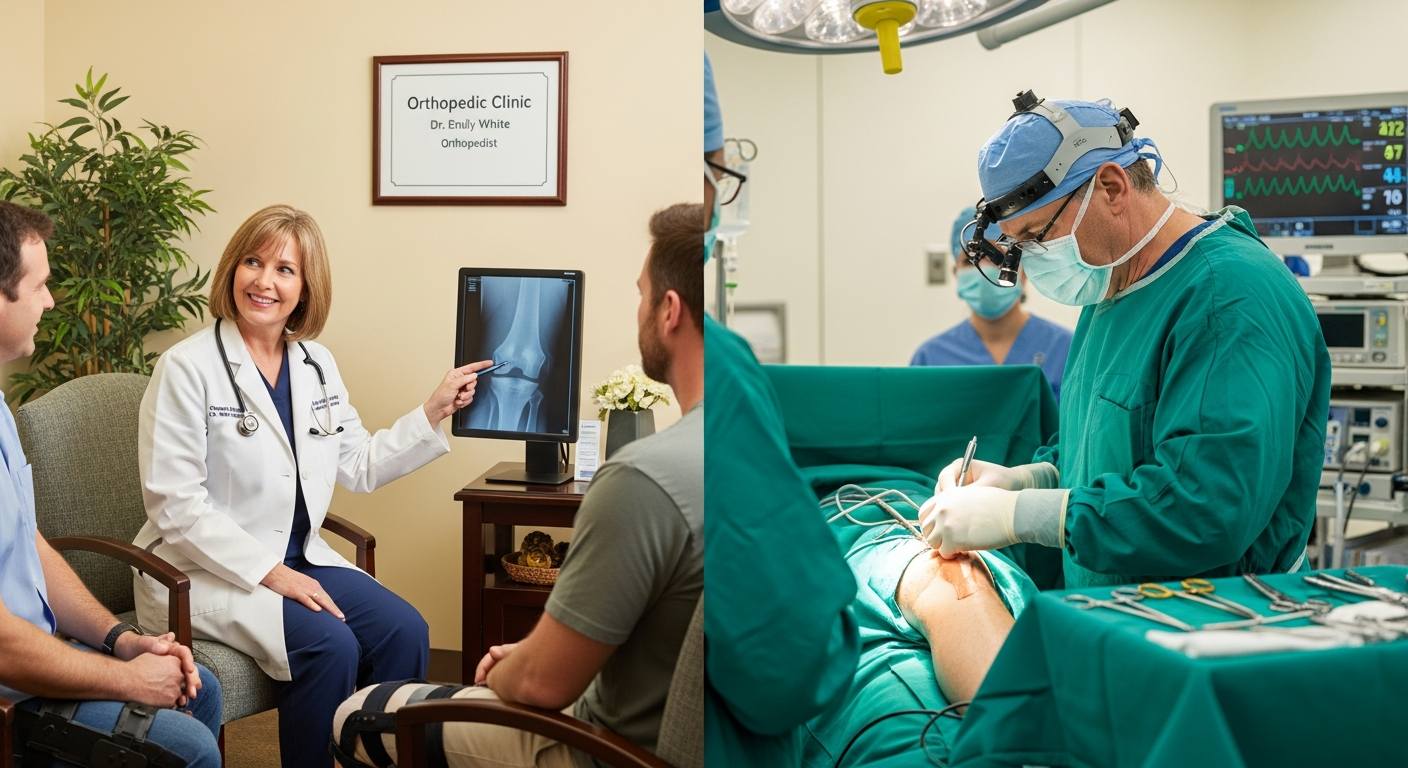
If you’re researching bone and joint care, you’ve probably seen the terms orthopedist and orthopedic surgeon. Are they the same thing? In simple terms, both are doctors specializing in the musculoskeletal system (bones, joints, muscles, ligaments, and tendons), but there is a nuance. An orthopedist (or orthopedic doctor) often focuses on non‑surgical treatments like physical therapy, braces, medications, and injections, whereas an orthopedic surgeon has the same background plus specialized surgical training to operate when needed. In fact, as Cleveland Clinic notes, an “orthopedic surgeon is also known as an orthopedist” – meaning every orthopedic surgeon is trained as an orthopedist, but not every orthopedist necessarily performs surgery.
Orthopedic specialists frequently work together to plan a patient’s treatment. For example, a group of orthopedic doctors might gather around a knee joint model (like in the image above) and review MRI scans to decide on the best care plan. Both orthopedists and orthopedic surgeons are part of this team approach. In practice, as one expert points out, all orthopedic doctors complete extensive surgical training, but they often try nonsurgical treatments first. This image illustrates how specialists balance different options — from therapy and injections to surgery — to help patients recover.
What Does an Orthopedist Do?
An orthopedist (also called an orthopedic doctor) is a physician who diagnoses and treats problems with the musculoskeletal system. These issues can range from chronic conditions like arthritis and back pain to sports injuries and minor fractures. Orthopedists typically start with conservative, non-invasive care. They might prescribe exercises with a physical therapist, fit you with a brace or cast, give anti-inflammatory medications, or use joint injections to reduce pain. For example, if you sprained your ankle or have tendonitis, an orthopedist will focus on rest, rehab exercises, or orthopedic supports before considering any surgery.
Importantly, while orthopedists are trained in orthopedic surgery during residency, they do not actually perform surgery themselves. Instead, they manage the injury or condition up to the point of surgery and can counsel patients on their options. They might say, “Let’s try physical therapy and pain meds for a few weeks,” then monitor your progress. If these measures aren’t enough, the orthopedist can refer you to an orthopedic surgeon for an operation. In short, orthopedists heal bones and joints with non-surgical tools and know when to involve a surgeon if the problem is severe.
What Does an Orthopedic Surgeon Do?
An orthopedic surgeon is also an orthopedist, but the title emphasizes that this doctor is fully qualified to operate. Orthopedic surgeons provide all the care orthopedists do – diagnosis, non-surgical treatments, and rehabilitation – and add surgical procedures when needed. In other words, they might start by trying the same therapies and braces, but if the injury or condition is serious, they can step into the operating room.
Common surgeries include arthroscopic repairs (like fixing a torn ligament), joint replacements (replacing a hip or knee damaged by arthritis), fracture fixation (using plates/screws to hold broken bones), and spinal procedures (such as for herniated discs). For instance, if you have a badly broken wrist or a torn rotator cuff, an orthopedic surgeon can surgically repair the damage. Cleveland Clinic explains that orthopedic surgeons diagnose the same range of problems as orthopedists – from arthritis to sprains – but as “they often help people get relief with nonsurgical therapies” as well. The difference is that when those therapies aren’t enough, they are trained and licensed to do the surgery.
Education and Training
Both orthopedists and orthopedic surgeons undergo years of rigorous training. They first attend medical school (earning an MD or DO degree) and then complete a 5-year residency in orthopedic surgery. During this residency, they learn to care for bones and joints across all methods – from casting and therapy to performing actual surgeries. Many then add a 1- or 2-year fellowship in a subspecialty (like sports medicine, spine, hand surgery, or joint replacement).
In total, becoming an orthopedist/orthopedic surgeon can take 10–14 years of education and training. After training, they often become board-certified (for example, by the American Board of Orthopaedic Surgery) to show their expertise. Because their primary training is surgical, all orthopedic surgeons are technically also orthopedists. One orthopedic center emphasizes that “every orthopedist is also an orthopedic surgeon because their training program is surgical in nature”. The title simply reflects whether they often use their surgical skills in practice.
Key Differences at a Glance
-
Treatment Focus: Orthopedists concentrate on non-surgical management of bone and joint issues. Orthopedic surgeons offer the same care plus surgery for complex cases.
-
Scope of Practice: Both can diagnose fractures, arthritis, tendon injuries, etc. But orthopedists will initially suggest therapies, braces, or medications, whereas surgeons will consider surgical repairs when those treatments are insufficient.
-
Training & Skills: Both roles require identical medical training (medical school + orthopedic residency). The surgeon title highlights that this doctor is prepared to operate if needed.
-
Referral: Often a patient sees an orthopedist first. If surgery is later needed, the orthopedist refers them to a surgical specialist. Alternatively, seeing an orthopedic surgeon from the start means you can skip that extra referral step if you already suspect a serious surgery might be required.
-
Work Setting: Both may work in clinics and hospitals. Orthopedists might spend more time in outpatient care and rehab settings, while orthopedic surgeons often split time between office visits and the operating room or surgical center.
-
Terminology & Spelling: “Orthopedic” and “orthopaedic” (with an ‘a’) are simply American vs. British spellings of the same field. Likewise, “orthopedist” and “orthopaedist” mean the same thing.

When to See an Orthopedist vs. an Orthopedic Surgeon
Choosing the right specialist depends on your situation:
-
Minor Aches or Injuries: If your pain or injury seems moderate (e.g. a mild sprain, early arthritis, or backache), start with an orthopedist. They will evaluate your condition and try non-surgical fixes first. For instance, they might fit a splint, suggest exercises, or give an injection to ease pain.
-
Major Injuries or Surgery Likely: If you have a severe issue (like a complex fracture, a torn ligament needing repair, or advanced arthritis), you can go directly to an orthopedic surgeon. These doctors are prepared to operate on serious problems.
-
Persistent Problems: When conservative treatment (therapy, medications, lifestyle changes) doesn’t help after a reasonable period, it’s appropriate to see an orthopedic surgeon. A good orthopedist will advise you if surgery becomes necessary and refer you accordingly.
-
Safety-Net Option: Many clinics have both orthopedists and surgeons on staff. In such cases, you can see whichever is more accessible. Often, clinics will have them working side by side, as one source advises, “our doctors and surgeons work side by side” for comprehensive care.
-
Special Cases: Certain specialized injuries (e.g. major sports injuries, spinal stenosis, bone tumors) almost always require an orthopedic surgeon’s involvement. If in doubt, ask your primary care doctor; they typically refer to an orthopedist or surgeon based on the suspected need.
Remember: starting with an orthopedist can sometimes avoid an unnecessary surgery, since many issues improve with non-invasive care. But there’s no harm in consulting a surgeon sooner if you want to explore all options. The important thing is expert care – both types of doctors have deep knowledge of the musculoskeletal system.
Synonyms and Spelling
You might also see the terms “orthopaedist” or “orthopaedic surgeon”. These are simply alternative spellings. In the UK and some other countries, “orthopaedic” (with an ‘a’) is standard, while in the US we usually drop the ‘a’ as “orthopedic”. It’s the same specialty – only the spelling differs. Whether you call the doctor an orthopedist or orthopedic surgeon, you’re referring to a specialist in bones and joints.
Conclusion
Both orthopedists and orthopedic surgeons are highly trained experts in musculoskeletal health. The main practical difference is that orthopedic surgeons have the surgical qualification to fix problems in the operating room, while orthopedists emphasize non-surgical care first. As one authoritative clinic puts it: orthopedists “often use nonsurgical treatments first” and reserve surgery for when it’s the best option. In day-to-day practice, many patients start with an orthopedist to try safer treatments, and then meet a surgeon only if needed.
Ultimately, what matters most is the doctor’s expertise and your specific condition. Either type of specialist will guide you through diagnosis and recovery. If you have doubts, you can always ask: “Is surgery likely for my problem, or can we manage it without cutting?” A knowledgeable provider will explain your choices clearly. No matter the title on the door, rest assured that both orthopedists and orthopedic surgeons are dedicated to getting you back to full strength safely and effectively.