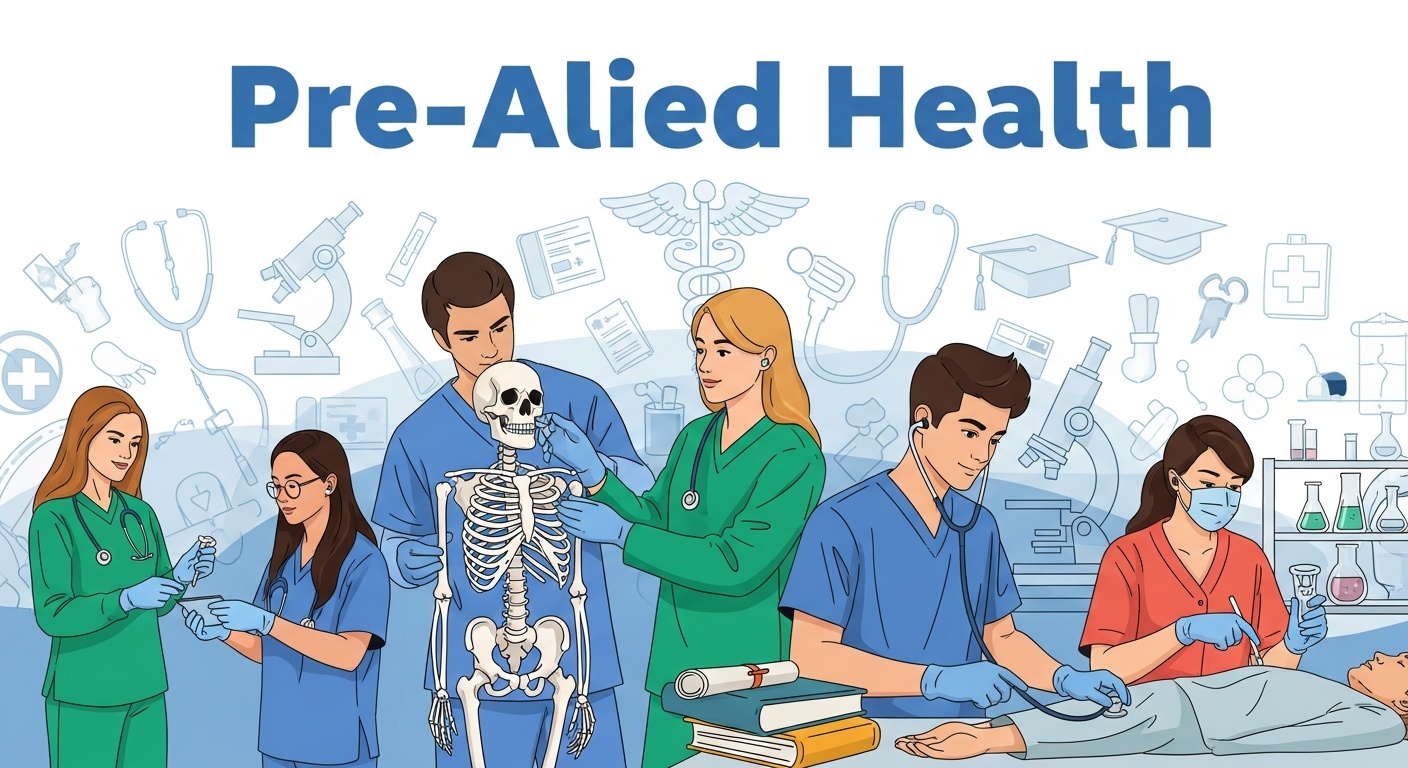
Pre-Allied Health is a college prep program of courses that builds your science foundation before you begin a health career degree. In other words, it’s a set of classes (often a certificate or two-year associate degree) that covers the key prerequisites for allied health professions. For example, Citrus College explains that a Pre-Allied Health degree “provides students with a strong biology and chemistry foundation” for careers like nursing, dental hygiene, medical laboratory technology, and physical therapy. Likewise, community colleges often offer a Pre-Allied Health Certificate that “prepares the student for entry into many health professional programs” by teaching courses needed for fields such as nursing, occupational therapy, lab technology, and radiologic sciences. In short, Pre-Allied Health is your stepping-stone: it gets you ready for the higher-level training required for allied health jobs.
Pre-Allied Health programs cover essential science and general education classes. Students will typically take courses like anatomy, physiology, microbiology, chemistry and biology – the subjects most health professions require. Many programs also include English, math/statistics, psychology and other general education courses, because all health programs want well-rounded applicants. For example, Rider University notes that pre-allied health students complete coursework in human anatomy, physiology, microbiology, chemistry, physics, math, psychology and English. In practice this means spending time in labs (for instance, practicing CPR or microscope work) as well as lectures on topics like cellular biology.
In a Pre-Allied Health lab, you might practice real medical skills – such as learning CPR on a mannequin – to gain hands-on experience. Many programs emphasize laboratory and clinical practice, not just lectures, because applying theory in a lab is crucial for health careers. For instance, Lackawanna College highlights that its Pre-Allied Health curriculum covers “fundamental subjects such as General Biology and Anatomy & Physiology” while offering hands-on lab experience to simulate real medical scenarios. These labs help you become familiar with the tools and techniques (like microscopes, specimen analysis, or patient exercises) that you’ll use later in your job.
Because allied health fields are very broad, pre-allied health can prepare you for many career paths. Allied health includes all health professions aside from doctors and nurses. For example, ASAHP (an alliance of allied health schools) explains that allied health professions involve prevention, diagnosis, and treatment support, and include roles such as:
-
Physical Therapist – helps people regain movement after injury or illness.
-
Occupational Therapist – assists patients to restore daily living skills (e.g. after an accident).
-
Radiologic Technologist/X-ray Tech – takes images of the body (X-rays, CT scans.
-
Respiratory Therapist – cares for patients with breathing or cardiopulmonary problems.
-
Medical/Dental Laboratory Technician – performs lab tests on blood, tissues, etc., under a pathologist’s direction.
-
Dental Hygienist – cleans teeth and educates patients on oral health.
-
Diagnostic Sonographer – uses ultrasound to image and help diagnose patients.
These are just a few examples – allied health jobs also include dietitians, speech-language pathologists, athletic trainers, and many others. Pre-Allied Health coursework is designed to meet the entry requirements for these programs. In many cases, specialized health degree programs (like nursing or physician assistant) have strict prerequisites. A pre-allied health program bundles those prerequisites into one path. For example, Citrus College notes its Pre-Allied Health degree “includes the prerequisites for Registered Nursing programs at two-year colleges,” meaning students get all the required classes for nursing school along with general health courses.

Key facts about Pre-Allied Health:
-
Foundation in Science: Programs focus on biology, chemistry, anatomy, physiology and related sciences.
-
Degree or Certificate: You might earn an Associate of Science (A.S.) degree or a shorter Certificate of Achievement after 1–2 years.
-
College Prerequisites: Coursework is carefully chosen to match what allied health schools expect (for nursing, PT, OT, etc.).
-
Broad Options: Completing pre-allied health keeps your options open – you can later decide which health field to apply for (nursing, therapy, lab science, etc.).
-
Growth Field: Healthcare jobs are growing fast – for instance, the U.S. Bureau of Labor Statistics projects about 16% growth for health careers in 2020–2030 – so having the right preparation is smart.
By the time you finish a Pre-Allied Health program, you will have a solid academic record in science and possibly some lab or clinical experience. Many allied health graduate programs look for candidates who have both good grades in these prerequisite courses and some healthcare exposure (shadowing or volunteering). That means taking pre-allied courses and doing things like observing professionals or working as a tech assistant can really help you stand out. Rider University points out that strong candidates for graduate health programs have taken these science courses and also show evidence of hands-on experience (volunteering, labs, etc.).
Finally, Pre-Allied Health is especially helpful if you’re not yet sure which health career you want. Because it covers a broad science base, it lets you explore different paths. One semester you might take anatomy and microbiology (good for any health field), and then try a volunteer gig in a hospital or rehab center. By completing a pre-allied track, you keep options open – you can apply later to nursing school or physical therapy school, for example – with the required coursework already done.
In summary, pre-allied health is simply the preparatory college coursework and advising that sets you on track for an allied health degree. It’s a practical first step if you aim to enter a healthcare career beyond nursing and medicine. You’ll build strong science and study skills, gain lab experience, and be well-prepared to compete for spots in specialized programs like nursing, radiography, therapy, or other allied health fields.