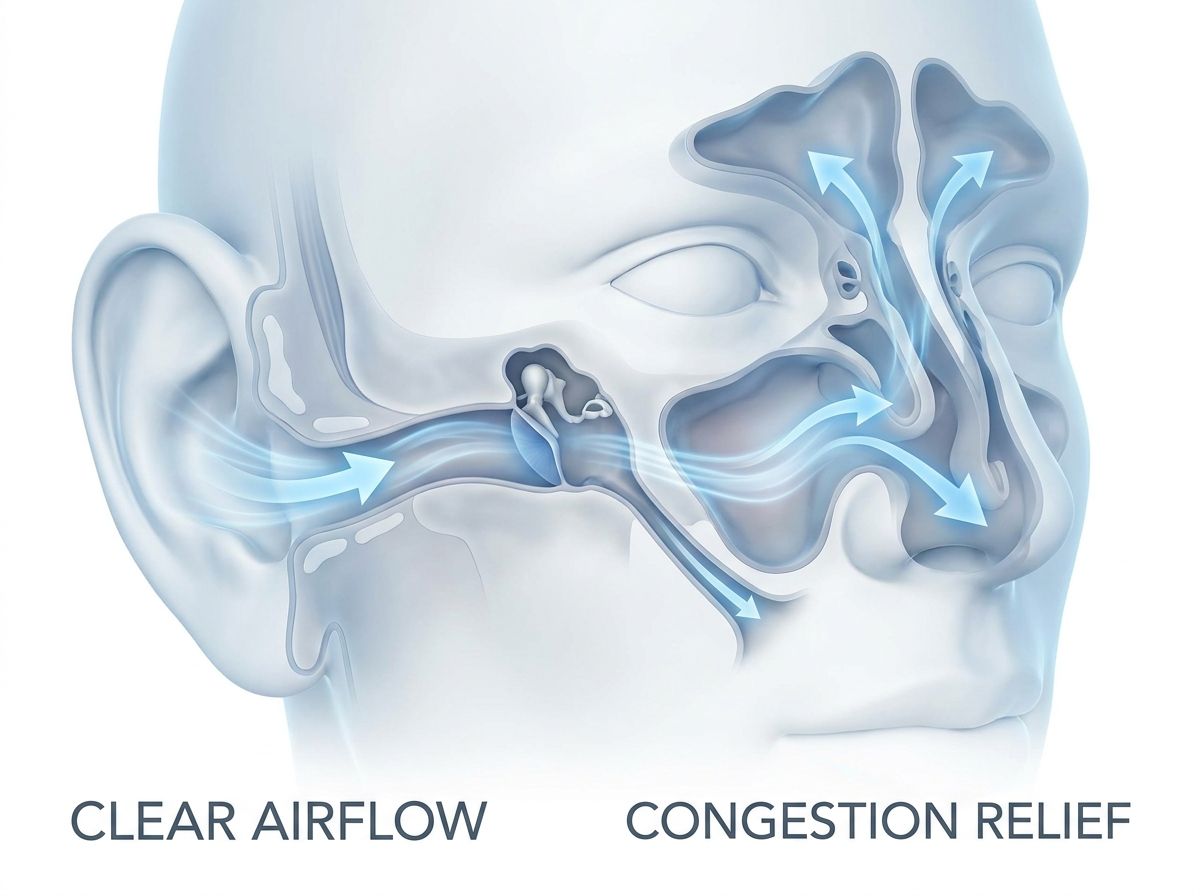
A stuffy nose is bad enough on its own. But when your ears start feeling like they’re packed with foam and every sound around you seems weirdly distant, that’s a whole different level of awful. Most people assume the ears are a separate issue and start Googling “ear blocked remedy” as if the two things have nothing to do with each other. They do, though. Very much so.
There’s a small channel connecting your nose and ears, the Eustachian tube. When your nasal tissue gets inflamed, it puts pressure on that tube and basically shuts it. And that’s where the ear fullness comes from. Not an ear infection necessarily, not water, just congestion traveling somewhere you didn’t expect it to.
Get the nose under control, and the ears usually sort themselves out. That’s the short version.
Why Congestion Messes With Your Ears
The Eustachian tube isn’t something you’d ever think about on a normal day. It just sits there keeping the air pressure behind your eardrum balanced. Silent, invisible, totally unremarkable, until it isn’t.
A cold hits, or pollen season gets bad, or you’re on a flight with a sinus infection (genuinely one of the worst experiences), and suddenly the lining of your nose swells up. That tube clamps shut. Pressure builds on the wrong side of your eardrum. Sometimes fluid settles in. And you spend the next few days feeling like someone turned the volume down on your entire life.
Doctors almost always start with the nasal congestion when a patient walks in complaining about blocked ears. Not because they’re ignoring the ears, because they know where the chain starts.
Nasal Sprays
If you need to feel better in the next twenty minutes, a nasal spray is your best bet. Afrin (oxymetazoline) and Otrivine (xylometazoline) are the two you’ll see everywhere. They work by shrinking the swollen tissue inside the nose, which then takes the squeeze off the Eustachian tube. Fast, effective, satisfying.
The problem, and this catches a lot of people off guard, is that you genuinely cannot use them for more than three days. Not “try to limit use,” actually stop at three days. What happens past that point is that your nasal tissue starts depending on the spray to stay open. Use it too long and when it wears off, your nose swells back worse than it was before. Now you need the spray just to breathe. It’s called rebound congestion, and it’s surprisingly easy to stumble into without realizing.
Oral Decongestants
Pills take longer, usually 45 minutes to an hour, before you notice anything. But because they go through your bloodstream rather than sitting in your nasal cavity, they reach the Eustachian tube directly. For ear pressure that won’t shift, that matters.
Pseudoephedrine, the original Sudafed, is the one ENT doctors tend to bring up specifically for ear congestion. You can still get it without a prescription in most countries, but you’ll need to ask at the pharmacy counter rather than grabbing it off the shelf. Phenylephrine, sold as Sudafed PE, is the easier-to-find version. Slightly milder, but fine if your symptoms aren’t severe.
One thing, both of these raise blood pressure and can speed up your heart rate. If you’ve got hypertension or any kind of cardiovascular history, don’t just check the label. Actually, talk to your doctor.
Combination Products
Sometimes the congestion isn’t from a cold. It’s from allergies, and in that case, a plain decongestant is only doing half the job. Claritin-D and Zyrtec-D both combine an antihistamine with pseudoephedrine, so you’re handling the allergic response alongside the blockage rather than one at a time.
If your sinuses are also painful and not just blocked, Advil Cold & Sinus combines ibuprofen with pseudoephedrine. Handles the inflammation and the congestion in one go.
Saline Rinses and Steroid Sprays
These two tend to get dismissed and they really shouldn’t.
Saline rinses, NeilMed being the most widely used, physically flush out mucus and whatever else has built up in the nasal passages. No drugs involved at all. You can use it daily without any concern about dependency or rebound. ENT specialists bring it up in almost every conversation about chronic congestion, and a lot of patients brush it off because it sounds too low-tech. That’s a mistake. For recurring congestion, it’s one of the most consistently useful things you can do.
Steroid sprays like Flonase are a longer game. One use won’t feel like much. You need several days of consistent use before the anti-inflammatory effect really takes hold. But that’s also kind of the point; they’re not masking the pressure, they’re reducing the inflammation that’s creating it in the first place. For someone whose ears block up repeatedly or whose Eustachian tube seems to be chronically unhappy, a steroid spray used regularly will usually outperform anything else on this list over time. Short-term decongestants are for getting through the day. Flonase is for actually fixing the pattern.