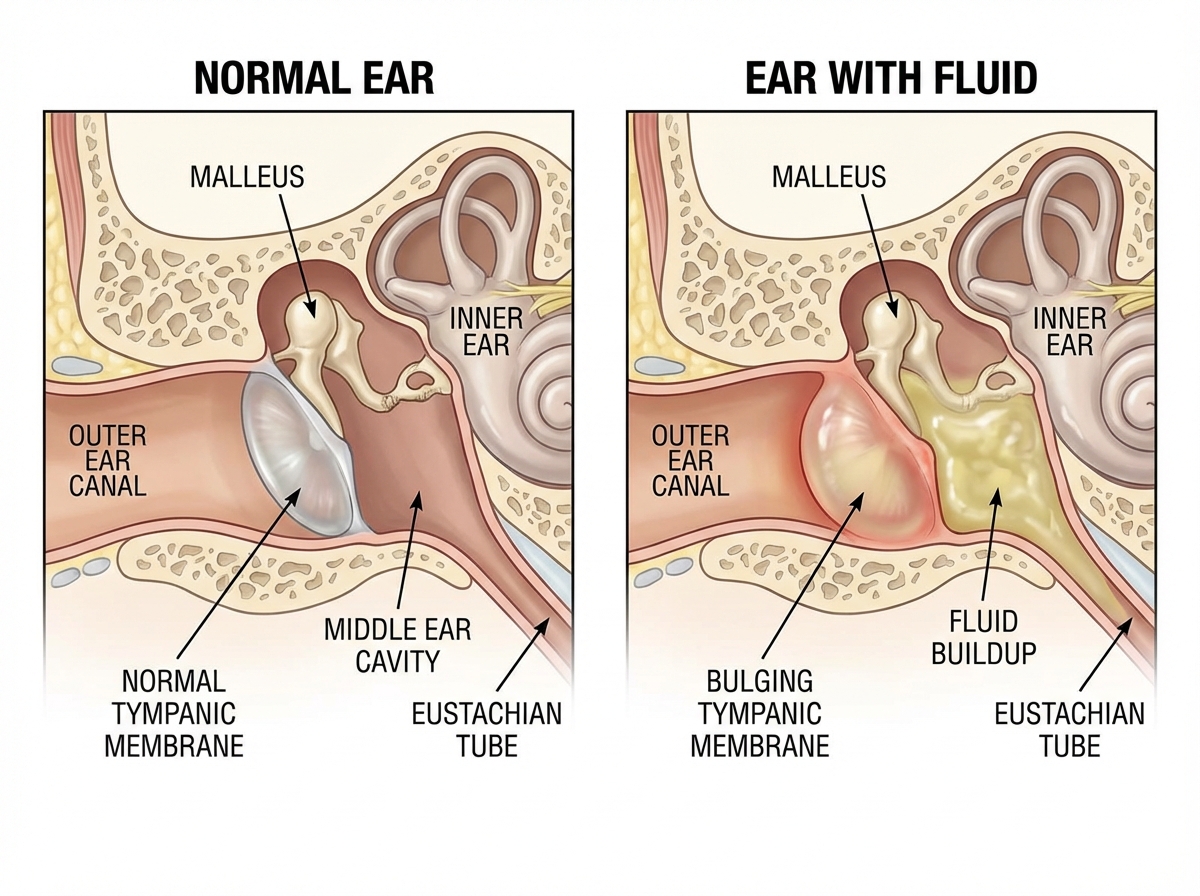
If a doctor recently told you there’s fluid behind your (or your child’s) eardrum, you’re probably wondering: what does that actually mean, and how is it different from a normal ear?
Here’s the short answer: a normal eardrum is clear, shiny, and moves freely. An eardrum with fluid behind it looks dull, discolored, and barely moves at all. This condition is medically called Otitis Media with Effusion (OME) — but most people just call it “fluid in the ear” or “glue ear.”
Let’s break it down in plain language.
What a Normal Eardrum Looks Like
A healthy eardrum is a small, thin membrane — about the size of a fingernail — that sits at the end of your ear canal. When a doctor looks inside a healthy ear with an otoscope, here’s what they see:
- Color: Pearly gray or slightly translucent — almost like frosted glass
- Surface: Smooth and shiny, reflecting light clearly
- Movement: It vibrates freely when sound waves hit it, and it responds easily to pressure changes
- Landmarks: A healthy eardrum has a visible cone of light (a light reflex) and the shadow of a tiny bone called the malleus can be seen through it
Think of a normal eardrum like a tightly stretched drum skin — taut, clear, and responsive to the slightest tap.
What a Fluid-Filled Eardrum Looks Like
When fluid builds up in the middle ear space behind the eardrum, everything changes. The eardrum doesn’t burst or disappear — it’s still there — but it takes on a very different appearance.
Here’s what doctors see when fluid is present:
- Color: Dull yellow, amber, gray, or even slightly blue — the eardrum loses its shiny, translucent quality
- Surface: Opaque and cloudy — that clear light reflex is gone or faint
- Bubbles or a fluid line: In some cases, doctors can actually see tiny air bubbles or a horizontal line where fluid meets an air pocket — like water in a half-full jar
- Position: The eardrum may be retracted (pulled inward, like a drum skin being sucked from behind) when pressure is negative, or bulging outward when there’s a buildup of infected fluid
The key visual difference? Shine vs. dullness. A normal eardrum reflects light. A fluid-filled one absorbs it.
How It Feels: Symptoms to Watch For
This is where things get interesting. Fluid in the ear doesn’t always hurt — which is why many people (especially children) go undiagnosed for weeks.
With a normal ear, you feel nothing. Hearing is clear, there’s no pressure, no discomfort.
With fluid behind the eardrum, you might notice:
- Muffled or reduced hearing — sounds feel like they’re coming through a thick blanket, or like you’re hearing underwater
- Fullness or pressure — a plugged sensation, similar to when your ears need to “pop” on an airplane
- Popping or crackling sounds — especially when swallowing or yawning, as the Eustachian tube tries to drain
- Mild balance issues — in some cases, especially in children, the fluid can affect their sense of balance
- No severe pain — this is what separates OME from an acute ear infection. Fluid in the ear is usually painless. If there is pain, the fluid may have become infected
In children, the most common sign parents notice is that the child isn’t responding to sounds clearly, or keeps turning up the TV louder than usual.
How Do Doctors Tell the Difference?
You can’t see inside your own ear, so this is where your doctor comes in. They use a few different tools:
Otoscope — the small handheld light device that lets a doctor look directly at the eardrum. A trained eye can spot the color and surface changes that signal fluid.
Pneumatic Otoscopy — this is the gold standard for diagnosing fluid. The doctor gently puffs a small amount of air into the ear canal and watches how the eardrum moves. A normal eardrum flutters freely. A fluid-filled eardrum barely moves at all — it’s stiff.
Tympanometry — a quick, painless test that measures eardrum movement electronically. It produces a graph called a tympanogram. A normal eardrum gives a peaked curve (Type A). A fluid-filled one gives a flat line (Type B) — no movement at all.
Why Does Fluid Build Up Behind the Eardrum?
The middle ear is connected to the back of your throat through a narrow passage called the Eustachian tube. This tube drains fluid and equalizes pressure. When it gets blocked or stops working properly — usually because of:
- A cold or upper respiratory infection
- Allergies
- Sinus congestion
- In children, enlarged adenoids
…fluid that the ear naturally produces can no longer drain. It gets trapped in the middle ear space and sits there behind the eardrum.
This is very common in children under age 5 because their Eustachian tubes are shorter and more horizontal, making drainage harder.
When Should You See a Doctor?
Fluid in the ear after a cold is actually quite common and often clears on its own within 4 to 8 weeks without any treatment. But you should see a doctor if:
- Hearing loss lasts more than 2–3 weeks — especially in a child, as it can affect speech and learning during this window
- There’s fever or significant ear pain — this may indicate the fluid has become infected (acute otitis media), which does need treatment
- Fluid has been present for 3 months or more — at this point, a doctor may discuss options like a short course of monitoring or, in persistent cases, referral to a specialist
- Balance problems appear — dizziness or stumbling in a child alongside hearing difficulty warrants prompt evaluation
- Fluid recurs frequently — repeated episodes of middle ear fluid need proper follow-up
Important: Do not try to diagnose this at home. Only a doctor using the right tools can confirm whether fluid is present and what type it is. Home remedies like ear drops will not treat fluid behind the eardrum — that’s on the inside of the drum, not the canal.
Quick Comparison: Fluid vs. Normal Eardrum at a Glance
| Feature | Normal Eardrum | Fluid-Filled Eardrum |
|---|---|---|
| Color | Pearly gray, translucent | Dull yellow, amber, or gray |
| Surface | Shiny, light reflex visible | Opaque, cloudy, no shine |
| Movement | Vibrates freely | Stiff, minimal movement |
| Position | Neutral | Retracted or bulging |
| Visible bubbles/line | No | Sometimes yes |
| Hearing | Clear and normal | Muffled, reduced |
| Pain | None | Usually none (pain = possible infection) |
| Symptoms | None | Fullness, popping, muffled sound |
Conclusion
A normal eardrum is one of the body’s unsung heroes — clear, flexible, and quietly doing its job. When fluid builds up behind it, the eardrum becomes a dull, stiff wall that struggles to carry sound properly. The good news? In most cases, the fluid resolves on its own.
The important thing is to know what you’re dealing with. If hearing loss, pressure, or that “plugged” feeling isn’t going away after a few weeks — get it checked. A 10-minute doctor’s visit can tell you everything you need to know.