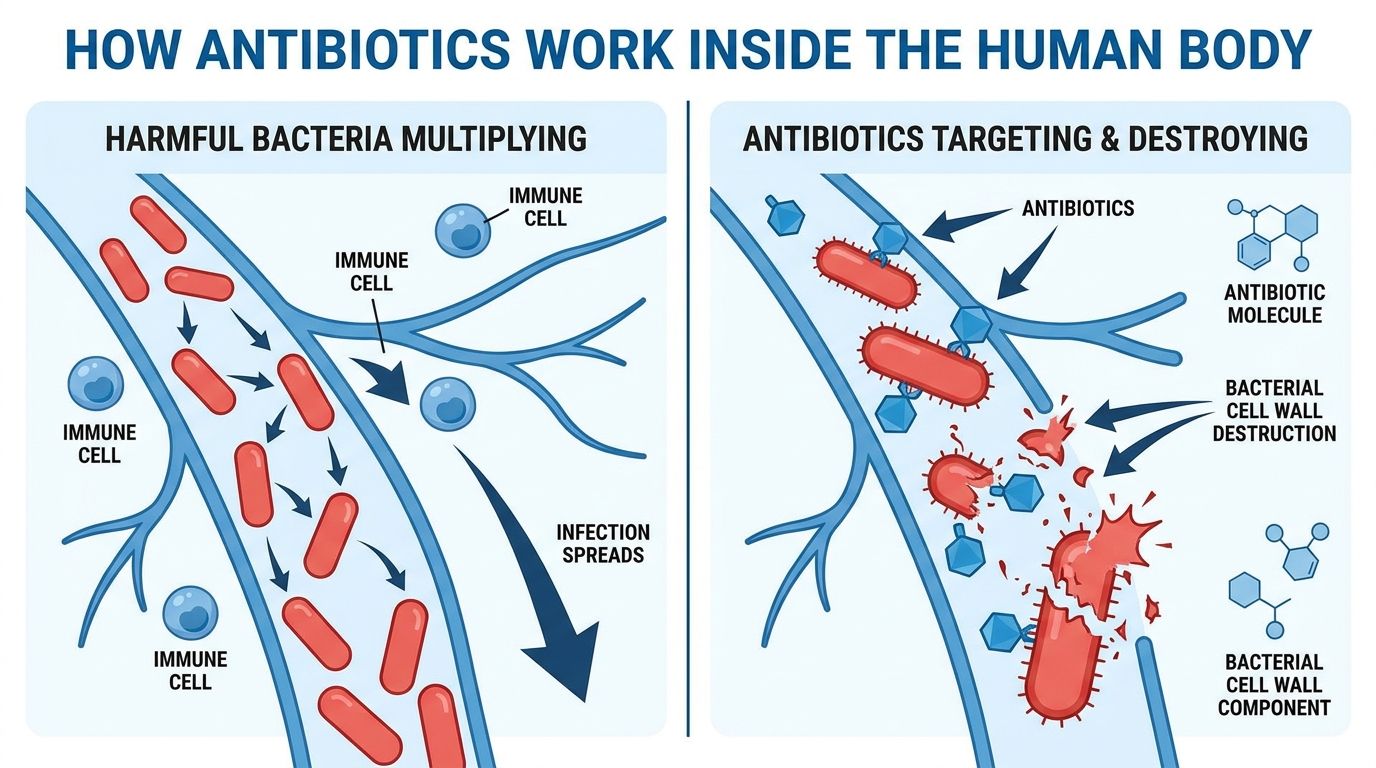
Most people have taken antibiotics at least once in their life. But ask them how antibiotics actually work and you’ll mostly get blank stares. Here’s the short answer: they either kill bacteria or stop bacteria from multiplying so your immune system can take care of the rest. That’s it at the core. According to Healthline, these medicines are built to go after bacterial cells specifically without touching your own, and that’s honestly what makes them one of the more impressive things in modern medicine.
But there’s a lot more going on once that pill enters your body. Let’s break it down in plain language.
Antibiotics Only Work on Bacteria, Not Viruses
Cold? Flu? COVID? An antibiotic won’t do a single thing for you. Those are viral infections, and antibiotics have no mechanism to deal with viruses at all. Yet somehow, people still ask their doctors for antibiotics when they’ve had a runny nose for three days. It doesn’t work that way.
What antibiotics are actually good at is dealing with bacteria. Strep throat, UTIs, bacterial pneumonia, skin infections caused by bacteria. That’s their territory. Using them outside of that territory is where things start to go wrong, but more on that later.
What Happens Once You Actually Take One
Once you take an antibiotic, it gets absorbed into your bloodstream and travels to wherever the infection is sitting. Then it goes to work. The way it works depends on which antibiotic you’ve been prescribed, because different ones attack bacteria in different ways.
Antibiotics destroy the bacterial cell wall
Bacteria are wrapped in a rigid outer wall that holds them together. Human cells don’t have this wall, which is actually a lucky break because it gives antibiotics a very specific target. Penicillin, for example, attacks this wall directly. Once it starts breaking down, the bacterial cell has nothing holding it together and basically falls apart. Dead.
Block bacteria from making proteins
Bacteria need proteins to function. Without them, they can’t grow, can’t repair themselves, can’t do anything. Inside every bacterial cell are tiny structures called ribosomes that build these proteins. Certain antibiotics essentially jam those ribosomes. Production stops. The bacteria slowly loses its ability to keep itself alive.
Stop bacteria from copying their DNA
To spread, bacteria need to divide. To divide, they need to copy their DNA first. Some antibiotics block the specific enzymes that handle that copying process. No DNA replication means no new bacterial cells. The infection gets stuck and can’t grow any further.
Punch holes in the bacterial membrane
A few antibiotics take a more direct route. They damage the outer membrane of the bacterial cell so badly that the cell starts leaking from the inside. Once that happens it’s over for the bacteria pretty quickly. This method tends to be used for tougher, more resistant bacterial strains.
Killing vs. Stopping: There’s a Difference
Not all antibiotics kill bacteria outright. Some just stop them from reproducing, and that distinction actually matters clinically.
Bactericidal antibiotics go in and kill the bacteria. That’s their whole job. Amoxicillin is a common example.
Bacteriostatic antibiotics don’t kill anything immediately. Instead they freeze the bacteria in place, stopping reproduction, buying your immune system time to find and destroy what’s left. It sounds less aggressive but it works just as well in many situations.
Your doctor picks between these based on the infection, how serious it is, and honestly, how your immune system is holding up.
Why You Still Feel Awful for the First Few Days
Here’s something nobody really explains well. Antibiotics start working almost immediately after you take them. But you probably won’t feel it for a couple of days and that’s completely normal.
The reason is that your symptoms aren’t only caused by the bacteria. A big chunk of how terrible you feel is your own immune system reacting, the inflammation, the fever, the exhaustion. That response doesn’t just switch off once bacteria start dying. It takes time to settle down.
So when you’re lying in bed on day two thinking the antibiotics aren’t working, they likely are. Give it another day.
That said, don’t stop taking them the moment you feel better. This part is important. If you stop early, you leave behind the bacteria that happened to survive the longest, the more resistant ones. They replicate. They pass that resistance on. And next time, the same antibiotic might not work for you.
Antibiotic Resistance Is Already Here
This isn’t a future problem. Bacteria have already evolved resistance to some of the most commonly used antibiotics, and it’s creating situations where infections that were easy to treat a decade ago are now genuinely difficult to manage.
It builds gradually. Someone takes an antibiotic for something viral and it does nothing except wipe out some of their gut bacteria. Someone else shares their leftover prescription. Another person stops their course three days in. Each of these situations gives bacteria an opportunity to learn, adapt, and develop ways around the drug.
The bacteria that survive partial treatments are not just unlucky survivors. They’re the ones with slight genetic advantages. They’re the future of that strain. And antibiotics don’t work on them anymore.
Your Gut Feels It Too
Something worth knowing: your gut is filled with bacteria, a lot of it genuinely useful. These bacteria help you digest food, support your immune system, and do a lot of quiet background work your body depends on. Antibiotics can’t always tell the difference between the bacteria making you sick and the bacteria keeping you healthy.
That’s why digestive issues are so common during a course of antibiotics. Bloating, loose stools, nausea. It’s not an allergic reaction in most cases. It’s just collateral damage.
Fermented foods and probiotics can help restore some of that balance once your course is done. Worth keeping in mind.
Conclusion
Understanding how do antibiotics work isn’t just medical trivia. It changes how you use them. Finish the full course. Don’t take them for viruses. Don’t share them. Don’t pressure your doctor into prescribing them when they aren’t needed.
These drugs have saved more lives than almost any other medical invention. But they only keep working if we treat them with some basic respect.