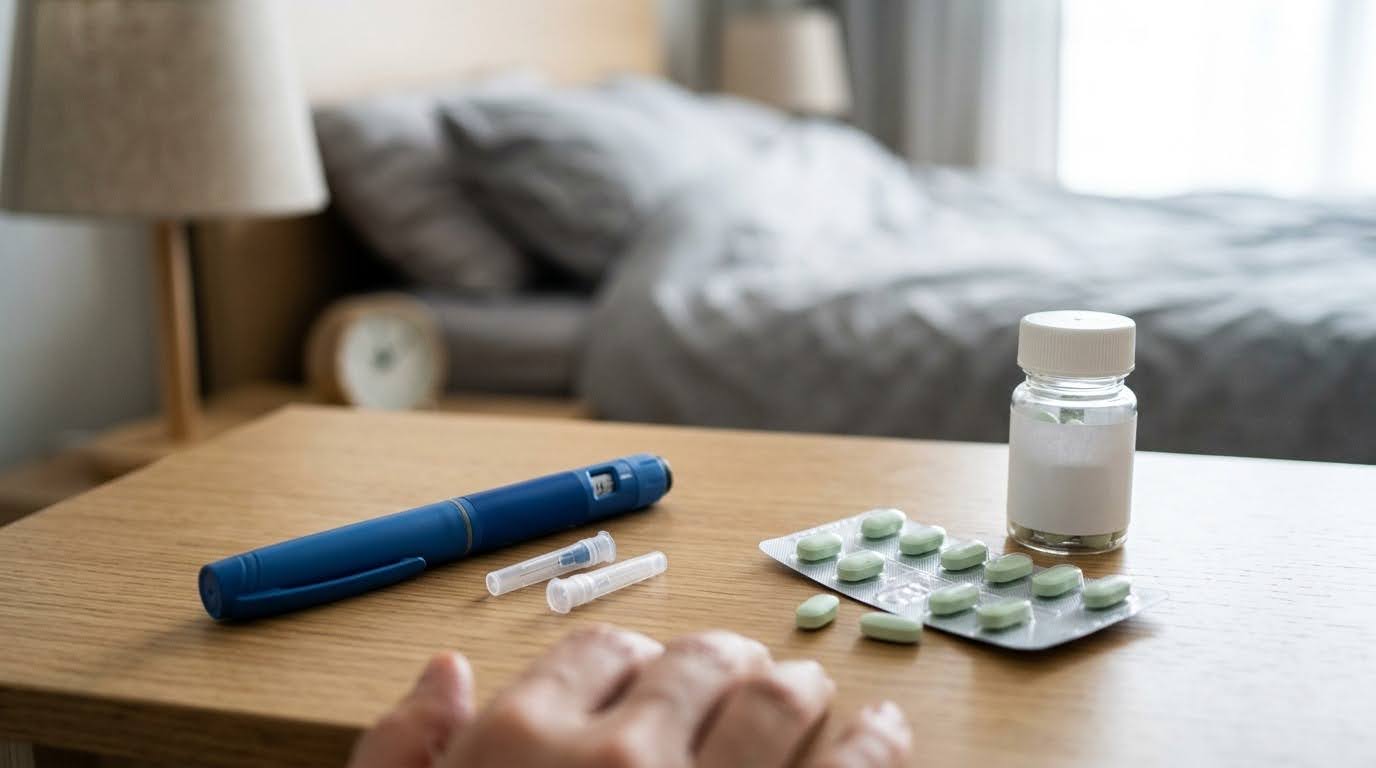
For years, if you wanted GLP-1 treatment for weight loss, the conversation was short. You were getting a weekly injection. That was the only option on the table.
Then December 2025 showed up and changed the whole discussion.
The FDA approved the Wegovy pill — an oral semaglutide tablet taken once daily — and suddenly the people who had been sitting on the fence had a new question: does the pill actually work as well, and which one should I be doing?
If you’ve already gone down the research rabbit hole on this, you know the answers are everywhere. Some people treat the pill like it’s a revolution. Others write it off as a weaker alternative. Neither take is fully accurate. The honest answer depends more on your specific life than it does on which format sounds more appealing in the abstract.
This is our attempt to give you a clear, practical look at both options — what the data says, what the day-to-day experience looks like, what it’s going to cost, and how to figure out which one actually fits.
Not sure where to start? TrimRX’s free online evaluation helps you find the right path.
First, a Quick Reminder of What These Medications Are Actually Doing
GLP-1 stands for glucagon-like peptide-1. It’s a hormone your gut releases naturally after you eat. It tells your brain you’re full, prompts your pancreas to release insulin, and puts the brakes on how fast your stomach empties.
In many people who struggle with weight, this system isn’t working the way it’s supposed to. The fullness signal fires weakly or too late. Hunger overrides it. The body keeps asking for food it doesn’t actually need.
GLP-1 medications don’t ask you to push through that with willpower. They step in and restore the signal directly, which is why so many patients describe the experience of being on them as fundamentally different from dieting. It’s not restriction. It’s your body finally responding the way it was supposed to.
Both pills and injections deliver this same effect. The difference is in how they get there, and that matters more than most people expect.
What Actually Changed in 2026
Before late 2025, oral GLP-1 therapy for weight loss didn’t exist in any meaningful form. Rybelsus, an oral semaglutide, had been around since 2019, but it was approved only for type 2 diabetes and its weight loss effects were limited at the doses available.
On December 22, 2025, the FDA approved the Wegovy pill — a 25 mg daily oral semaglutide tablet — specifically for chronic weight management. That was genuinely new. Then in April 2026, Eli Lilly’s oral option, Foundayo (orforglipron), got its own approval and became the second pill on the market.
So for the first time, the choice is real. Pill or injection. Both FDA-approved, both for weight loss, both available. Worth understanding before you pick one.
The Comparison People Actually Want: How Do They Stack Up?
Weight Loss Results
Let’s start with the number most people want to know.
Injectable semaglutide, specifically Wegovy at 2.4 mg taken weekly, produced average weight loss of about 14.9% of body weight over 68 weeks in the STEP 1 trial. Someone starting at 250 pounds would lose roughly 37 pounds on that trajectory.
The Wegovy pill, in the OASIS 4 Phase 3 trial, produced 16.6% average weight loss over 64 weeks among people who completed the full course. About a third of participants hit 20% or more. When you factor in people who stopped early, the average drops to 13.6%.
These numbers are close enough that Novo Nordisk described the results as comparable, and the FDA’s approval reflected that assessment.
Injectable tirzepatide is a different category. The dual mechanism hitting both GLP-1 and GIP pathways has consistently produced 20 to 22% average weight loss in clinical trials, which is meaningfully higher than either semaglutide format. If maximum weight loss is the goal, tirzepatide is currently the strongest tool available.
The newest oral option, Foundayo (orforglipron), sits at around 12.4% average weight loss at the highest dose over 72 weeks. Effective, but a step below the Wegovy pill.
How You Actually Take Each One
Injectable GLP-1s work on a once-weekly schedule. You do a small subcutaneous injection — stomach, thigh, or upper arm — and that’s your dose handled for the next seven days. The pens are straightforward to use, most people describe the injection itself as almost painless, and a lot of patients genuinely appreciate the rhythm of it. One thing per week. Done.
The pill is daily, and it comes with conditions that matter. You take it first thing in the morning, on an empty stomach, with no more than four ounces of plain water. Then you wait at least 30 minutes before eating, drinking anything else, or taking other medications.
That might sound simple on paper. In practice, it adds a layer of friction to every single morning. Semaglutide is a fragile molecule that degrades in the digestive system, and the pill’s bioavailability depends on a specialized absorption enhancer that only works under precise conditions. A sip of coffee, a second medication taken too soon, anything that disrupts the timing — and you’ve compromised what actually gets absorbed.
For someone with a consistent morning routine and no other daily medications, that’s manageable. For someone with kids to get out the door, an irregular schedule, or a handful of other morning prescriptions, it’s a real consideration. Not a dealbreaker, but something to be honest with yourself about.
Side Effects
Both formats share essentially the same side effect profile because they’re both GLP-1 receptor agonists. Nausea is the most common one, especially in the early weeks when doses are being increased gradually. Constipation, diarrhea, and mild stomach discomfort show up too, though for most people these ease off after the first month or so.
A couple of format-specific differences are worth knowing:
Injectable medications bypass the gastrointestinal system entirely. If you have any digestive conditions — gastroparesis is the main one — injections are the more reliable option because absorption isn’t affected by gut variability.
The oral pill’s empty-stomach requirement can make early nausea feel more intense for some people, since there’s nothing in the stomach to soften the effect when it kicks in.
Injections can occasionally cause minor redness or irritation at the injection site. It’s usually temporary and minor.
Both carry the same standard warnings: not recommended for anyone with a personal or family history of medullary thyroid carcinoma or MEN2 syndrome, and always used under licensed medical supervision.
The Lifestyle Question
This is where a lot of the decision actually lives.
The pill tends to be a better fit if you have a genuine aversion to needles — not just mild discomfort, but the kind that has actively stopped you from pursuing treatment before. It also works well for people with dexterity limitations that make self-injecting difficult. And since pills don’t require refrigeration, they’re logistically easier for frequent travelers.
Injections tend to work better for people with unpredictable morning schedules, anyone already managing a complex daily medication routine, and people prioritizing maximum weight loss (especially if tirzepatide is on the table). Weekly dosing is also simply easier to sustain long-term than a daily protocol with specific timing requirements.
One data point worth knowing: within three weeks of the Wegovy pill launching in January 2026, around 170,000 people had been prescribed it — faster uptake than any previous GLP-1 medication. A large portion of that demand came from people who had wanted GLP-1 therapy for a while but had been held back specifically by needle aversion. The pill isn’t better. But for that group, it’s more accessible.
What It’s Going to Cost
Brand-name Wegovy pill runs approximately $150 per month at lower doses and $300 to $400 at full therapeutic dose, for uninsured patients under Novo Nordisk’s self-pay pricing.
Brand-name injectable Wegovy has a list price around $1,350 per month, though manufacturer programs have brought that down for cash-pay patients in some situations.
Brand-name Zepbound is in a similar range before discounts.
For most people who aren’t using insurance, compounded GLP-1 therapy through a licensed telehealth provider is where the math actually makes sense. At TrimRX, compounded semaglutide starts at $199 per month and compounded tirzepatide starts at $349 per month. Same active ingredients, licensed providers, licensed compounding pharmacies, shipped to your door.
Worth being clear: compounded medications are not FDA-approved products the way brand-name versions are. The FDA approves the branded drugs, not compounded versions. But the active ingredients are identical, and the prescribing and preparation happen under medical and pharmacy licensure.
See current TrimRX treatment pricing.
The Thing Nobody Talks About Enough: Whether You’ll Actually Stay on It
All the clinical trial data in the world assumes people took the medication consistently for the duration of the study. Real life is messier than that.
Weekly injections have a genuine practical advantage here. One thing per week is easier to remember and maintain than one thing per day with a specific protocol attached. A missed injection here or there has less cumulative impact than regularly mistiming or skipping a daily pill that requires a 30-minute fasting window.
Research on Rybelsus, the original oral semaglutide for diabetes, has shown that adherence in real-world settings varies quite a bit depending on how well patients understand and stick to the administration requirements. The stricter the protocol, the more opportunity there is for it to go sideways over time — particularly over months and years.
None of this means pills don’t work. They clearly do for a lot of people. But the “convenience of a pill over a needle” framing can be misleading. A 30-second injection once a week is, for many people, genuinely more sustainable than a daily ritual with timing constraints. That’s worth factoring in honestly.
A Third Option Worth Knowing About
A lot of people approaching this decision think it’s binary: pill or injection. But the more important question might be which medication, and the answer there points somewhere a lot of people overlook.
Tirzepatide, the active ingredient in brand-name Zepbound and Mounjaro, activates both the GLP-1 and GIP hormone pathways. That dual mechanism consistently produces greater weight loss than semaglutide in any form — around 20 to 22% of body weight in clinical trials versus 13 to 17% with semaglutide.
If you’re already open to weekly injections, the question of pill versus injection becomes less important than the question of semaglutide versus tirzepatide. For people whose primary goal is meaningful, lasting weight loss, that distinction matters more than the delivery format.
So How Do You Actually Decide?
Here’s the honest version of a decision framework:
If needle aversion or dexterity is genuinely the barrier, the pill removes it. Go oral. Just make sure you can realistically maintain the daily fasting protocol before you commit.
If maximum weight loss is the priority and injections aren’t a barrier, tirzepatide is the strongest option currently available. The data is not particularly close.
If you want a proven, simple, affordable option and you’re fine with weekly injections, compounded semaglutide does the job well and has years of real-world data behind it.
If your mornings are unpredictable, you take multiple daily medications, or you travel constantly, injections are probably the more sustainable choice in practice, whatever your initial intuition says about pills.
The format matters less than finding something you can actually stay on consistently. That’s what produces results over time.
How TrimRX Works
TrimRX starts with a free online evaluation — a detailed health questionnaire reviewed by licensed providers who look at your full picture before recommending anything. No clinic visits. No insurance required.
If you qualify, you get a personalized treatment plan, a prescription, and your medication shipped to your door. Compounded semaglutide and compounded tirzepatide are both available, and a dedicated care team is accessible around the clock throughout your treatment.
Quick Answers to Common Questions
Is the Wegovy pill as effective as the injection? The clinical trial results are close enough that the FDA considered them comparable. Most people on the pill see 13 to 17% weight loss. Most people on injectable semaglutide see a similar range. The pill may feel more convenient for some, but it requires consistent daily compliance with a strict fasting protocol to get there.
Can I switch between injections and the pill? Yes, but coordinate the timing with a licensed provider. Switching from injectable to oral semaglutide typically requires waiting a week after your last injection before starting the daily pill.
Which option produces the most weight loss? Injectable tirzepatide. It’s not close. The dual GLP-1 and GIP mechanism consistently outperforms semaglutide in any format across clinical trial data.
Is compounded semaglutide the same as brand-name Wegovy? Same active ingredient. Not the same FDA-approved product. Compounded versions are prepared by licensed compounding pharmacies and prescribed by licensed providers, but they haven’t gone through the FDA’s individual drug approval process. The cost difference is significant — brand-name Wegovy runs over $1,000 per month without insurance at full dose.
What if I can’t afford to stay on it long term? This is worth discussing with your provider before you start. Some people find that after a period of meaningful weight loss, they can step down to a maintenance dose at lower cost. Others stay on the same dose indefinitely. Going into the treatment with a long-term cost plan is a smarter approach than figuring it out after you’ve already started seeing results.